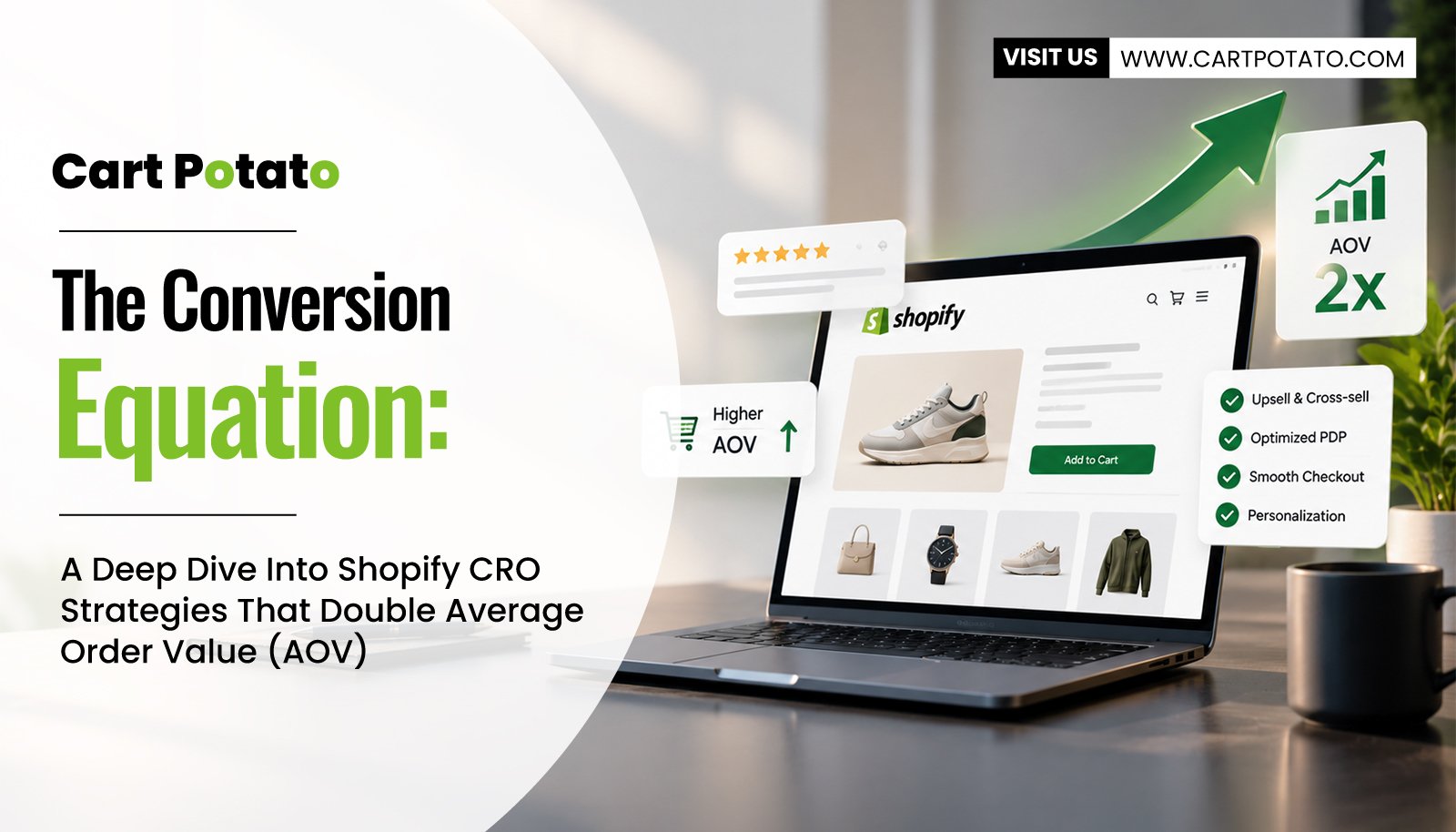
The Conversion Equation: A Deep Dive Into Shopify CRO Strategies That Double Average Order Value (AOV)
Average order value (AOV) is a useful ecommerce metric because it shows how much customers spend per order on average. Increasing it can support revenue growth without relying exclusively on acquiring more visitors. However, AOV should not be improved at the expense of customer trust, conversion rate or long-term satisfaction. The most effective Shopify CRO strategy helps shoppers find relevant products, understand their options and confidently complete a purchase.
There is no single change that will double AOV for every store. Results depend on product category, price points, customer intent, margins, traffic quality and the current shopping experience. A structured optimisation programme tests ideas against a baseline and keeps changes that create profitable, sustainable improvement.
1. Understand the AOV Equation Before Changing the Store
Average order value is generally calculated by dividing total order revenue by the number of orders in the same period. Define consistently whether the revenue figure includes discounts, shipping, taxes or refunds, and use the same definition when comparing periods. Segment results by acquisition channel, device, product category, new versus returning customers and promotion type to avoid misleading averages.
AOV should be reviewed alongside conversion rate, gross margin, revenue per visitor, refund rate and repeat purchase behaviour. For example, a large discount may increase basket size but reduce profit. A bundle may lift order value while lowering conversion if shoppers feel pressured to buy items they do not need. The objective is profitable customer value, not a larger cart at any cost.
2. Use Product Bundles to Make Complementary Choices Simple
Bundles can increase order value by bringing related items together in a useful package. A skincare store might group a cleanser, moisturiser and sunscreen; a coffee brand might pair beans with filters; a homeware store could suggest matching accessories. The bundle should solve a real customer need and make the combined value easy to understand.
Test curated bundles, mix-and-match sets and tiered packages where appropriate. Explain what is included, show the individual items and make savings transparent if a discount is offered. Monitor bundle attachment rate, margin, conversion and returns. If customers frequently buy the same combination independently, a bundle may reduce friction; if products have different audiences, a bundle may confuse them.
3. Create Relevant Cross-Sells and Upsells
Cross-selling recommends a complementary product, while upselling presents a higher-value version or configuration. Both work best when the recommendation is context-aware. A product page might show a compatible accessory, while a cart page could suggest a useful add-on that does not delay checkout.
Avoid generic recommendation blocks filled with unrelated items. Use product relationships, purchase history and category logic where available, but ensure recommendations remain understandable and privacy-conscious. Limit the number of choices so the main purchase stays clear. Measure the incremental revenue generated by recommendations—not simply the number of recommendation clicks.
4. Design Free-Shipping Thresholds Around Real Margins
A free-shipping threshold can encourage shoppers who are close to the minimum to add another item. For example, a progress message can show how much more a customer needs to spend to qualify. The threshold should be based on shipping costs, product margins, average basket size and customer behaviour rather than an arbitrary round number.
Test the threshold against a control group or a comparable period, and watch for changes in conversion rate, contribution margin and abandoned carts. If the threshold is too high, customers may leave rather than add products. Consider suggesting affordable, relevant products that help customers reach the threshold without making the store feel manipulative.
5. Improve Product Pages to Reduce Purchase Doubt
Product pages influence both conversion and basket composition. Clear photography, useful specifications, sizing information, delivery estimates, returns guidance and authentic customer reviews help customers make confident decisions. When shoppers understand the product, they are more likely to select the right variant and consider relevant accessories.
Shopify Theme Development can support reusable product-page components, but design changes should be guided by evidence. Make the primary call to action prominent, keep variant selection intuitive and avoid distracting pop-ups. For products with compatibility or sizing requirements, explain those details before the customer adds the item to the cart.
6. Build Focused Shopify Landing Pages
A landing page should match the promise that brought the visitor to the site. Paid campaigns, email promotions and organic search pages may need different messaging, but each page should present a clear value proposition, relevant products, credible proof and a visible next step. Strong Shopify Landing Pages remove unnecessary distractions and help visitors compare options.
A Landing Pages company India or a Shopify Landing Pages company India may assist with campaign-focused page design and testing, but the process should begin with audience intent and a measurable hypothesis. Avoid creating near-identical pages solely to target keyword variations. Each landing page should provide distinct value, answer a specific need and maintain consistency between the ad or search snippet and the page content.
7. Simplify Cart and Checkout Experiences
Unexpected costs, unclear delivery dates, forced account creation and confusing cart controls can interrupt purchase intent. Show key costs as early as practical, make quantity updates easy and ensure discount codes behave predictably. On mobile, test tap targets, form fields, payment options and the path back to product details.
Cart recommendations should be helpful rather than obstructive. Avoid repeatedly covering the checkout button with pop-ups or adding products automatically without clear consent. The purpose of Shopify CRO is to remove uncertainty and unnecessary effort, not to trick customers into spending more.
8. Use Personalisation Carefully
Personalisation can improve product discovery when it responds to meaningful signals such as the current category, a customer’s selected preferences or previous purchases. Examples include replenishment reminders for consumable products, compatible accessories or recently viewed items. Recommendations should be transparent and should not depend on collecting more personal data than necessary.
Start with simple rules and evaluate their performance before investing in complex systems. Segment results to determine whether personalisation helps new visitors, returning customers or specific product categories. Always provide a useful default experience when data is unavailable.
9. Run a Consistent Testing Programme
Conversion optimisation works best as a repeatable process. Identify a friction point, state a hypothesis, choose one primary metric, define guardrail metrics, run the test for an appropriate period and document the outcome. Tests may cover bundle placement, recommendation copy, threshold messaging, product-page structure or cart layout.
Avoid declaring a winner after a few conversions or changing multiple major elements at once. Seasonality, traffic sources and promotional campaigns can affect results. When formal A/B testing is not feasible, use a careful before-and-after analysis, compare similar segments and acknowledge the limits of the evidence.
10. Improve the Technical Foundations
Slow pages, broken scripts, layout shifts and excessive apps can undermine even strong merchandising. Audit theme code, image sizes, third-party scripts and app overlap. Keep tracking implementations consistent so that add-to-cart, checkout and purchase events are recorded accurately. Confirm that analytics reports use a stable definition of revenue and orders.
For more complex requirements, Shopify App Development or a custom storefront may be appropriate, but additional technology should have a clear purpose and maintenance owner. Headless Ecommerce can offer presentation flexibility, yet it can also increase implementation and testing complexity. Choose the simplest architecture that supports the conversion opportunity.
11. Connect CRO to SEO and Customer Support
Organic visitors often arrive with a specific question. Useful category copy, clear product information, descriptive internal links and helpful FAQs can connect search intent to the right products. Do not force every keyword into every page; use terms naturally where they accurately describe the service or product. For a Shopify Development Company or Shopify Agency serving other businesses, educational content should answer buyer questions before making a service offer.
Customer support conversations can reveal recurring objections: confusing sizing, unclear compatibility, shipping concerns or uncertainty about returns. Turn these insights into product-page improvements and track whether support contacts or return reasons change. CRO is not only a design exercise; it draws on merchandising, operations, analytics and customer service.
12. Create a Practical 30-Day AOV Improvement Plan
Week 1: Establish a baseline for AOV, conversion rate, margin, revenue per visitor and cart abandonment. Review performance by device, channel and product category, and identify the biggest customer questions.
Week 2: Choose one high-impact opportunity, such as a complementary bundle, clearer product information or a relevant cart recommendation. Confirm the economics and define success metrics before development.
Week 3: Implement the change on a limited set of products or traffic where practical. Test mobile and desktop journeys, check analytics events and ensure customers can easily remove or change suggested items.
Week 4: Review results against the baseline or control, including guardrail metrics. Keep the change only if the evidence supports it, record the learning and choose the next experiment. A sequence of validated improvements is more dependable than a broad redesign based on assumptions.
Conclusion: Increase AOV by Creating More Customer Value
The strongest Shopify CRO programmes help shoppers discover relevant products, understand the value of a purchase and complete checkout with confidence. Bundles, cross-sells, thoughtful free-shipping thresholds, clearer product pages and focused landing pages can all contribute to higher AOV when they fit the customer’s needs and the store’s margins.
Treat every idea as a hypothesis, measure its impact and protect conversion rate and customer trust. Whether a brand manages its own Shopify Store or works with Shopify Experts, the long-term advantage comes from learning continuously. A sustainable increase in average order value is the result of better merchandising and a smoother shopping experience—not pressure tactics.

Let’s Move
Forward Faster
You’re Doing the Hard Work. Let’s Make It Pay More.
Schedule a call and optimize your store for ROI.